Future City Competition 2018: Helping Senior Citizens

The Future City Competition Regional Finals took place in Chicago on Saturday, January 20th at the University of Illinois at Chicago's Student Center East building. The competition is the culmination of months spent by junior high school teams and their engineering mentors to create a city of the future. Students submit a working project plan, present their solutions via a virtual city design (using SimCity), write an essay describing the unique attributes of their city and their solution to the year’s challenge (Helping Senior Citizens); build a scale model, and give a presentation to judges. Regional winners represent their region at the National Finals in Washington, DC.

For the past four years, the Illinois Section of ITE has participated as a special award judge at the Future Cities Competition. This year, 20 different professional organizations sponsored and gave 25 special awards at the competition. Josh Harris, the current Section Secretary, and Tom Szabo, the current Section Director of Activities, represented the Illinois Section of ITE this year as special award judges. Josh and Tom were tasked with reviewing each team's city and awarding the Excellence in Transportation Safety and Operations Award. This award was given to the team that had the most innovative future city design that demonstrated a safe and efficient surface transportation system that considered growth and preservation of the environment.

This year, Josh and Tom determined that the winning city deserving of this award was Flextopia, presented by students from Independence Jr. High School from Palos Heights, Illinois.  Flextopia featured multiple forms of safe and efficient transportation systems, including a Hyperloop for long distance traffic, urban transport pods for regional traffic, and voice interactive self-driving vehicles for local traffic. Sidewalks and paths were available for bicyclists and pedestrians throughout the city. The presenters for this team discussed each transportation option with incredible detail.
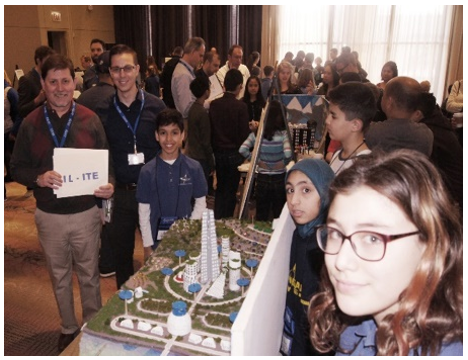
Future City.PNG

The Illinois Section of ITE was happy to not only sponsor the Future City Competition in Chicago again this year, but to participate as judges. We look forward to participating in this event again next year!

ITE Webinar: Connected Vehicles, Smarter Cities, and Modern Signal Timing

On December 6th, 2017, the Illinois Section of ITE hosted a ITE Webinar: Connected Vehicles, Smarter Cities, and Modern Signal Timing focus on how traffic engineering strategies will change in the years ahead. The webinar instructor was Peter Koonce from Portland State University and chair of the Transportation Research Board Committee on Traffic Signal Systems.  ITE held the event in one (suburban) location.  Christopher B. Burke Engineering, Ltd., in Rosemont, offered their training room, and provided printed handouts and snacks.

Peter Koonce started the webinar by giving an overview of the presentation and the Webinar’s first topic, Signal Timing Manual Second Edition. The second edition is focusing on better understanding of signal timing fundamentals for new practitioners.  There are four new chapters added to the second edition manual for more advanced users and only includes the necessary material. Additionally, the new edition’s material is organized in a way that it is presented once and referenced as needed in other parts of the document, and makes use of expanded graphics, which helps to improve explanation of more complex topics.

Webinar_1.png

Peter Koonce continued the webinar explaining what comes beyond traffic, in essence, how we will move people and things better and adapt to industry progressions and technological advancements. Cars are still a dominant mode of transportation, transit takes on larger share and designing for safety is increasing.

He moved to the next topic of The Smart City Challenge, including Transportation Information, Big Data, Mobility as a Service and Connected and Autonomous Vehicles. The smart city concept is illustrated in following image. One of the significant factors of this concept is the open data cloud (UB Mobile PDX) to integrate products, analyze and store. Mobility Marketplace is another significant factor to prevent the private automobiles from sitting idle and to improve mobility as a service. The user interface is to promote accessibility to devices and necessary training to serve all users.

Connected vehicles was the next topic of the webinar which is established in 2015 to “Transform the Way Society Moves”. The goal is to improve safety, reduce emission, obtain real-time travel information and regional coordination using CV technology (Vehicle to Vehicle - “V2V” and Vehicle to Infrastructure - “V2I” applications).

Webinar_2.PNG

Transit signal priority will provide transit vehicles preferential treatment at signalized intersections and improves schedule reliability and reduces travel time. In conclusion, transit priority has the potential to provide significant benefits and it requires coordination between transit and traffic staff.

The webinar viewing was well attended with seventeen attendees.  The Technical Group looks forward to doing future viewings in more suburban locations.  The Section thanks all the participants for attending and Christopher B. Burke Engineering, Ltd. for providing the venue and snacks.